

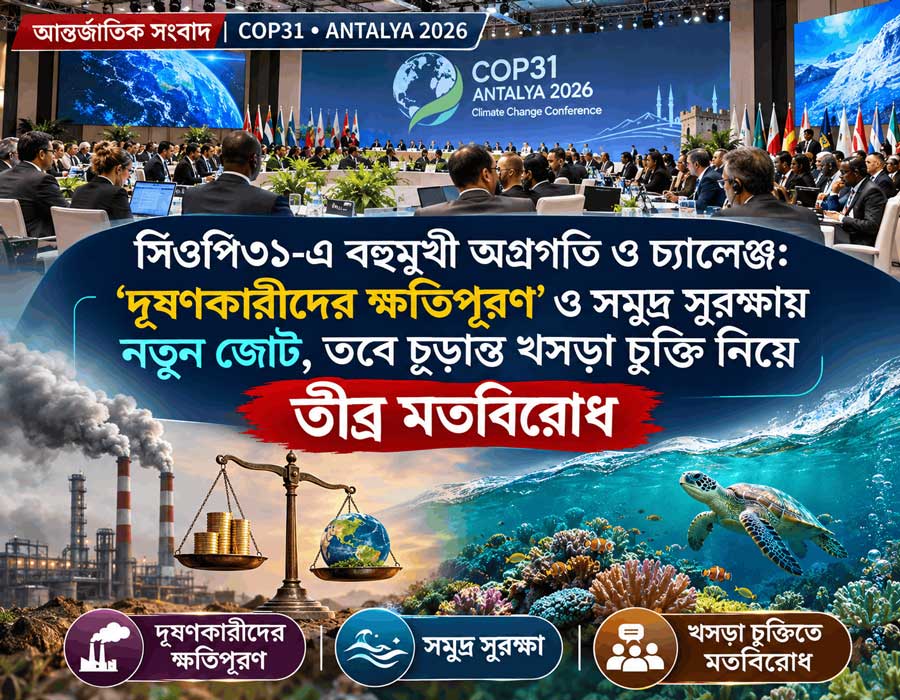
The Antalya summit exposed the widening gap between global climate commitments and the urgent needs of vulnerable communities in the world. The world came to Antalya, Turkey, expecting climate leadership. It left with another uncomfortable reminder that political promises are often easier to make than to fulfil. The 31st United Nations Climate Change Conference (COP31), which concluded on 22 November 2026, failed to secure an overarching political agreement, exposing deep divisions among governments over fossil fuels, climate finance, and the future of global climate cooperation.
After two weeks of talks and an unusual extension of discussions, the summit failed to achieve the big result that the climate crisis needs. For millions of people already experiencing the devastating consequences of global warming, this was not simply a diplomatic disappointment. It was another postponement of the action on which their lives and livelihoods depend.
The key issue was obvious: governments failed to reach a common agreement to help transition away from fossil fuels quickly. Disagreements over the language of the proposed Antalya Pact, particularly references to fossil fuel phase-out, electrification, and carbon capture, prevented consensus. Countries also remained divided over the scale, sources, and delivery of climate finance.
The absence of an overarching agreement does not mean that every negotiation failed. COP31 produced some limited outcomes. Countries worked on talks about adaptation indicators, added three more years to the Just Transition Work Program, and backed efforts to speed up electrification and clean energy. Nearly 100 countries backed a voluntary global electrification pledge targeting a 35 percent share of electricity in final energy consumption by 2035.
These developments deserve recognition. Still, individual efforts and minor choices won’t fix the lack of serious political commitment needed for the climate crisis.
The unfinished business of climate finance
For developing countries, particularly those on the front lines of climate vulnerability like South and Southeast Asian countries, finance remains the defining test of international climate solidarity.
COP31 failed to establish a credible pathway for delivering the commitment to triple adaptation finance by 2035. Nor did it resolve fundamental disagreements over predictable funding, accessibility, accountability, and the responsibilities of developed countries.
This failure carries serious implications for countries such as Bangladesh. Rising sea levels, coastal erosion, salinity intrusion, riverbank erosion, cyclones, floods, and increasingly unpredictable rainfall threaten food security, public health, housing, and livelihoods.
Consider a farmer in Kurigram struggling to recover from recurrent flooding or a family in Satkhira rebuilding its home after another devastating cyclone. These communities cannot wait indefinitely for international financial commitments to become reality. They need accessible resources, climate-resilient infrastructure, agricultural support, safe drinking water, and effective disaster preparedness.
Climate finance should not be treated as charity. It is a matter of climate justice, shared responsibility, and international accountability. Countries that have contributed disproportionately to historical greenhouse gas emissions must demonstrate greater responsibility in supporting those least responsible for the crisis but most exposed to its consequences.
The fossil fuel dilemma and the just transition
Another major disappointment was the failure to secure a stronger commitment to transition away from fossil fuels. Despite years of scientific warnings and international negotiations, the world remains divided over the future of coal, oil, and natural gas.
The resistance to meaningful fossil fuel commitments raises a fundamental question: How can the international community expect to achieve its climate objectives while continuing to protect the economic and political interests that sustain dependence on carbon-intensive energy?
A just transition must be more than a diplomatic expression. It requires investment in renewable energy, affordable electricity, green employment, technology transfer, and social protection for workers and communities dependent on fossil fuel industries.
Developing countries should not be forced to choose between economic development and environmental protection. Wealthier nations must help create the financial and technological conditions that make a fair energy transition possible.
A summit of unprecedented scale, but insufficient delivery
More than 92,000 people registered for COP31, making it the largest climate conference in history.
The gathering brought together government representatives, international organizations, development agencies, environmental activists, businesses, researchers, and civil society groups.
Yet the extraordinary scale of participation raises an uncomfortable question: are international climate conferences becoming any more effective at delivering decisions?
The environmental cost of bringing tens of thousands of participants to a single location, many by air travel, also deserves consideration. The emissions associated with such gatherings are real. Their justification must ultimately rest on meaningful outcomes.
This is not an argument against multilateral cooperation. Climate negotiations remain essential, and the work of diplomats, scientists, and negotiators deserves respect. However, the international community must examine whether its current approach is producing results proportionate to the resources and expectations invested in it.
The voices of vulnerable communities must become more influential than the interests represented by powerful negotiating blocs.
From Antalya to action: A test for COP32
The consequences of COP31 extend beyond the negotiating halls of Turkey. They challenge the credibility of the international climate governance system itself.
As COP32 moves to Ethiopia, the global community can gain back trust by making real commitments instead of more bold promises and missed deadlines.
Three main things should guide the next step in climate talks: a) dependable and easy funding for adaptation; b) a fair plan to stop using fossil fuels; and c) improved ways to make sure global promises lead to local climate action. Climate resilience must reach farmers, fishing communities, women, children, Indigenous populations, and people living in disaster-prone coastal and riverine areas. Women and girls, who frequently carry disproportionate responsibilities during climate emergencies, must have meaningful participation in climate planning and resource allocation.
Ultimately, climate action should be measured not by the number of delegates attending a summit, the length of its declarations, or the frequency of ministerial speeches. It should be measured by how many lives are saved, jobs are protected, emissions are cut, ecosystems are repaired, and resources are given to the communities that need them most.
Antalya has exposed the limits of political consensus when national interests outweigh collective responsibility. The world cannot afford to turn COP32 into another conference of postponed promises. The climate crisis is not waiting for another diplomatic breakthrough. Neither should the people living on its front lines.
Nicholas Biswas is a media professional and a recipient of the United Nations Population Fund (UNFPA) Media Award. He can be reached at [email protected]