

Sexual and reproductive health and rights (SRHR) are central to human dignity, gender equality and sustainable development. Yet in Bangladesh, millions of women, girls and young people still struggle to get accurate information, affordable care and the freedom to make their own reproductive choices.
Progress in family planning and maternal health is real, but taboos, child marriage and policy gaps persist. SRHR is not merely a health issue but a matter of rights, justice and development.
SRHR services in Bangladesh are provided through a multi-tiered network of government agencies, international organizations, non-governmental organizations (NGOs), and private sector partners.
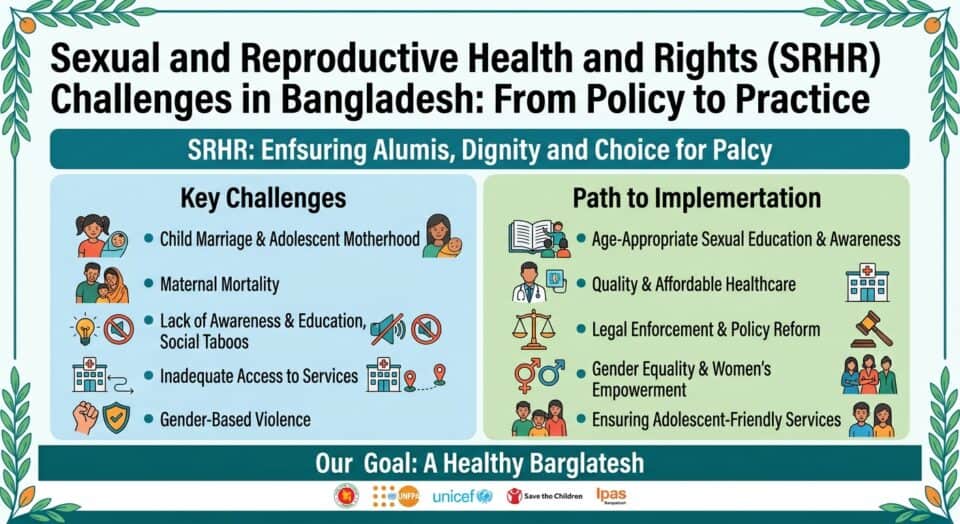
SRHR: Ensuring Rights, Dignity and Choice for All
SRHR is the idea that everyone can choose freely and wisely about their sexual and reproductive health, without being treated unfairly, pressured, or harmed.
The four key aspects of SRHR
- Sexual Health: Promoting physical, emotional and social well-being in relation to sexuality.
- Reproductive Health: Ensuring access to family planning, maternal healthcare, safe childbirth and other reproductive health services.
- Sexual Rights: Protecting individuals’ rights to bodily autonomy, dignity, privacy, equality and freedom from sexual violence.
- Reproductive Rights: Ensuring the freedom to decide whether, when and how many children to have, and access to accurate information and appropriate healthcare.
SRHR is essential for:
- Preventing maternal deaths and unintended pregnancies.
- Ensuring access to contraception and family planning.
- Protecting adolescents from child marriage, sexual abuse and exploitation.
- Preventing and responding to gender-based violence.
- Promoting gender equality, human rights and women’s empowerment.
- Ensuring access to safe, respectful and affordable healthcare.
In Bangladesh, SRHR helps improve maternal health, prevent child marriage, increase access to family planning, and protect the rights and dignity of women, girls, and other vulnerable people
Maternal Health: Reaching Every Woman
The Bangladesh Sample Vital Statistics, published by the Bangladesh Bureau of Statistics, puts the maternal mortality ratio at 136 deaths per 100,000 live births in 2023, down from 153 the year before.
Yet most deaths are preventable. Haemorrhage, early pregnancy and too few skilled birth attendants remain the main drivers, while cervical cancer and obstetric fistula damage women’s health and dignity.
Women in rural, remote and low-income communities carry the heaviest burden. Costs, distant facilities, too few trained professionals and delays in emergency care all add up.
Stronger referral systems and good antenatal, postnatal, and post-abortion care are very important. Affordable emergency obstetric services must be provided with respect, kept private, and without discrimination.
Child Marriage and Adolescent Health
According to the Multiple Indicator Cluster Survey, 47.2 per cent of women aged 20–24 were married before 18, and about 13 per cent before 15. Poverty, climate-related displacement, weak social protection and harmful norms drive the practice in our country.
The consequences follow quickly. The adolescent fertility rate is around 113 births per 1,000 girls aged 15–19, among the highest outside sub-Saharan Africa, and pregnancy and childbirth complications are a leading cause of death among adolescent girls. Early marriage ends schooling, narrows prospects and erodes girls’ control over their own bodies and futures.
Adolescents are further failed by the lack of age-appropriate sexual and reproductive health education. Puberty, contraception, consent and infections are taboo in many homes and classrooms, so young people turn to rumour and social media. Schools, families and communities must jointly provide accurate, culturally sensitive information that builds safety and respect rather than fear.
The government, with UNFPA and UNICEF, has committed to ending child marriage by 2030 under Sustainable Development Goal 5.3. Enforcement and community engagement must now match that commitment.
Family Planning and the Right to Choose
Family planning is among Bangladesh’s success stories. Modern contraceptive prevalence is around 62 per cent, but it has stagnated and varies by region in the country, with lower use in areas such as Chattogram and Sylhet. Pills are the most popular method (about 29 per cent of married women), while long-acting and permanent methods account for only about 8 per cent.
The National Family Planning Strategy 2025–2030, launched in October 2025 with UNFPA support, aims to shift the focus from population control to rights-based empowerment. A year-long door-to-door campaign is due to begin on 1 December 2026. Its test will be whether it offers real choice, with trained counsellors and a full range of methods, rather than pressure to meet targets. Family planning is the freedom to decide whether, when and how many children to have.
Menstrual Regulation and Post-Abortion Care
Induced abortion is illegal under the Penal Code of 1860, except to save a woman’s life. Since 1979, however, menstrual regulation (MR) has been available as part of family planning services: by manual vacuum aspiration up to 10–12 weeks after the last menstrual period, or with medication (MRM) up to nine weeks.
In practice, access is uneven. Few trained doctors, stigma, and low knowledge about eligibility rules drive some women to unsafe providers. Many of these women later need care for bleeding and other problems after abortion. Responsibility is divided.
MR falls under the Directorate General of Family Planning, while post-abortion care is managed by the Directorate General of Health Services. This may reduce coordination. Authorised MR and compassionate, non-judgmental post-abortion care must be strengthened, alongside voluntary contraception.
Preventing Sexually Transmitted Infections
HIV prevalence among the general population is low, but gonorrhoea, syphilis and other infections remain public health concerns. Female sex workers, men who have sex with men, transgender people and people who inject drugs bear a disproportionate burden.
Many people know little about infections, and embarrassment keeps them from testing. They turn instead to pharmacies and informal providers, often resulting in incorrect diagnoses. NGOs and UNFPA run awareness and testing programmes, but coverage must expand. Confidential, affordable, non-discriminatory services are essential, and public messages should stress prevention and timely care, not blame.
Policy Gaps and Institutional Responsibilities
Bangladesh has no single national SRHR policy; provisions are scattered across documents such as the National Population Policy 2012 and National Health Policy 2011. Key gaps include:
- Unmarried adolescents are largely excluded because services prioritise married couples and maternal care.
- Sexual health and psychosocial support receive less attention than reproductive metrics.
- Men are rarely targeted, leaving contraception mainly to women.
- People with disabilities, sexual and gender minorities and women in climate-affected coastal areas lack tailored services.
- School life-skills education is undermined by taboos, weak teacher training and political resistance.
Responsibility is spread across ministries. Health and Family Welfare, Bangladesh, delivers services but struggles with privacy and frontline training. Education is meant to embed comprehensive sexuality education, but oversight is weak.
Women and Children Affairs works on child marriage and violence against women. However, it does a bad job working with the police. National surveys show that about seven out of ten married women face violence from their partners. Budgets, meanwhile, still favour maternal logistics over rights-based training.
Bangladesh needs a complete plan for sexual and reproductive health that connects maternal health, family planning, youth health, managing menstruation, preventing STIs, stopping violence, and providing education. It should set clear service standards, improve data collection, and allow complaints about discrimination or poor care.
The Government, civil society, and development partners such as UNFPA, UNICEF, UNAIDS, FHI 360, Ipas Bangladesh, Save the Children, MSI Reproductive Choices, IPPF, Population Council, Radda Barnen, the Obstetrical and Gynaecological Society of Bangladesh (OGSB), Reproductive Health Services Training and Education Program (RHSTEP) and others must coordinate themselves and be backed by sustained funding..
The Way Forward: A Matter of Dignity and Development
Five steps stand out.
- First, strengthen maternal and reproductive healthcare in underserved areas.
- Second, introduce age-appropriate SRHR education through schools, communities and reliable digital platforms.
- Third, intensify action against child marriage and gender-based violence.
- Fourth, make contraception, menstrual regulation, post-abortion care and confidential STI services available without discrimination.
- Fifth, involve women, adolescents and marginalised communities in designing the programmes meant to serve them.
Progress should be judged not by national averages but by whether the poorest woman and the most marginalised person can get care when they need it.
Bangladesh cannot reach its development ambitions while women die of preventable causes and girls marry before adulthood. The goal is to build more clinics and a society where information is easy to get, services are low-cost, privacy is protected, and reproductive choices are made safely and freely.
That takes political commitment, investment and the courage to challenge harmful norms. A woman’s health, a girl’s future and every person’s reproductive autonomy are not privileges. They are rights.
Nicholas Biswas
is a media freelancer and a recipient of the United Nations Population Fund (UNFPA) Media Award.


