

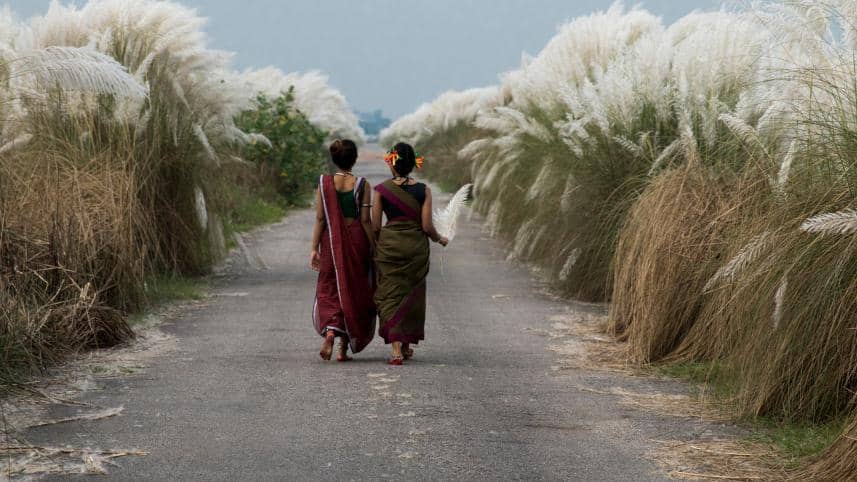
There was a time when the arrival of Sharat Kal (Autumn season) meant something. In the Bengali calendar, Sharat (Autumn) comes after the monsoon. The weather is supposed to become cooler, the sky clearer, and nature more serene. At least, that is how many of us remember it from our childhood.
Back when I was in school, seasonal descriptions of Sharat Kal (Autumn season) were wonderful. We learned that the sky remains blue. We talked about dew on grass in the morning, white Kash flowers in fields, fluffy clouds in the blue sky, and the smell of Shuli, Kanchan, and Kamini flowers in the air. We were told that the monsoon would give way to a pleasant atmosphere. However, now
For children growing up in Dhaka today, much of that description may sound like something from another world.
In September, summer is supposed to be over. Yet the heat remains. As I write this, my weather alert is showing severe heat for tomorrow, with a maximum temperature forecast of around 35°C. Anyone who has been in Dhaka in September knows that the weather app’s readings don’t always match how it actually feels in the city. With humidity, direct sunlight, concrete surfaces, traffic and very limited shade in many parts of the city, 35°C can feel considerably harsher.
Perhaps the strangest part is that Dhaka does not simply experience the heat of the surrounding climate. Dhaka’s urban heat island effect means that its densely built-up areas can remain warmer than surrounding less-developed areas. Concrete and asphalt absorb and store heat, buildings alter airflow, vegetation is replaced by construction, and human activities add further heat to the urban environment. Research has documented an increasing urban heat-island intensity in Dhaka. So even when the calendar tells us that summer has passed, Dhaka can continue to feel very much like summer.
And then there is the sky. One of the most beautiful images associated with Sharat Kal is a deep blue sky with soft white clouds floating across it like cotton. But how often do we actually see that kind of sky in Dhaka anymore? Sometimes the blue is there, but it appears washed out behind haze and pollution. At other times, the sky can look pale and grey rather than blue. Air pollution is a serious environmental problem in Dhaka. Fine particulate matter and other pollutants are affecting the city’s atmosphere. Recent monitoring across Dhaka has documented significant concentrations of PM2.5 and black carbon, with pollution varying by location and season.
Still, Sharat Kal (Autumn season) has not completely disappeared from Dhaka. You can still find Kash Phool (Catkin) if you know where to look. In various places around the city, tall white Kash Phool can be found growing across open land. Every vacant field in Dhaka is vulnerable to construction, roads, commercial development or some other form of urban expansion. The few remaining places where Kash Phool can still grow are increasingly treated as destinations for reels and photoshoots. There is, of course, nothing wrong with photographing the beauty of Kash Phool (Catkin). However, the question is how long these places will remain. If the open land disappears, the Kash Phool (Catkin) will disappear with it. And eventually, Sharatkal(Autumn season) may survive on our social media feeds only.
The same thing can be said about dew. In school we knew that during Sharat Kal (Autumn season) dew could be seen on the tips of grass in the early morning. But when was the last time many of us actually walked across a large grass field at dawn and noticed dew under our feet? Many children growing up in Dhaka today might say they have never actually seen dew, as the open green spaces where they could experience it are becoming increasingly scarce.
The flowers we learned about are still around too. But they seem to belong to private spaces. A lucky person with a balcony, rooftop or small garden can grow Shiuli, Kanchan or Kamini. For many others living in this densely populated city, having enough space to grow and enjoy such plants can feel like a luxury. Nature has not disappeared completely. But it has become fragmented. A tree here, a rooftop garden there, a small field beside a river, a patch of Kash Phool (Catkin) beside a road, a few remaining wetlands.
Overall, the Sharat Kal of our childhood is facing various challenges. Perhaps that is why the textbook description of Sharat Kal (Autumn season) can feel so strange to someone living in Dhaka today. The real tragedy is not that Dhaka has lost every trace of Sharat Kal (Autumn season). It hasn’t. The blue sky still appears on some mornings. The clouds still float above us. Kash phool still bloom in some forgotten corners. Shiuli still falls from trees. Dew still forms on grass. There are still places where, for a brief moment, Dhaka can resemble the city we remember from our schoolbooks.
The problem is that these experiences are becoming less ordinary. They are becoming things we have to search for. Because one day, a child may open a Bengali textbook and read the description of Sharat Kal (Autumn season) and, instead of remembering the feeling, simply ask:
“Why doesn’t Sharat Kal (Autumn season) look like this anymore?”