
OP-ED — PART ONE OF TWO
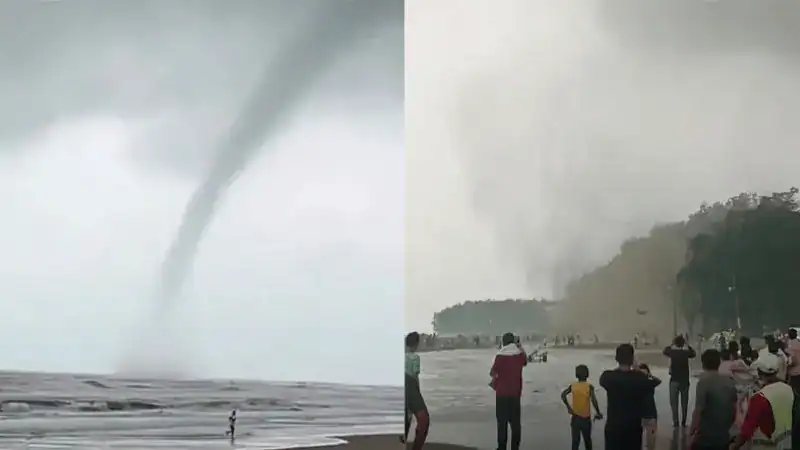
Yesterday, on 17 July 2026, at around 2:45 pm, a tornado touched down at Sugandha Point on Cox’s Bazar beach. It lasted three to five minutes. According to local reporting, it damaged tourist chairs and umbrellas placed along the beach, triggered panic among visitors, but caused no reported casualties. Social media clips and photographs went up almost instantly, showing a dark funnel spinning in from the Bay of Bengal. And then, as quickly as it had arrived, it was gone. By evening, vendors were already resetting their chairs.
It would be easy to file this away as a strange, three-minute curiosity, a viral clip, a talking point, nothing more. I want to argue the opposite: that this tornado, precisely because it was so brief and so survivable, is one of the more honest warnings Cox’s Bazar has received this year.
Consider what preceded it. Earlier this month, torrential monsoon rains triggered flooding and landslides across southeastern Bangladesh. Reuters reported at least 44 deaths and more than one million people stranded across seven districts, including Chattogram, Cox’s Bazar, Bandarban, and Moulvibazar, with over 267,000 households becoming inaccessible. In Cox’s Bazar, landslides also killed Rohingya refugees, including women and children, underscoring the vulnerability of hillside settlements during intense rainfall.
Other situation reports placed the toll even higher: by mid-July, floods and landslides had reportedly killed 51 people and affected more than one million, while some areas received 200 to 500 millimetres of rain. The Guardian’s weather tracker reported at least 53 deaths nationally and noted that Chattogram recorded 412.3 millimetres of rain in 24 hours, its highest July rainfall in 42 years.
None of these events is, on its own, unprecedented. Bangladesh has always lived with cyclones, floods, river erosion, salinity, storm surges, and landslides. The National Adaptation Plan of Bangladesh 2023–2050 recognizes the country as one of the world’s most climate-vulnerable nations and identifies climate-induced disasters as a central threat to lives, livelihoods, infrastructure, and development. Bangladesh was ranked seventh on the 2021 World Climate Risk Index, despite contributing only a small share of global emissions.
What has changed is the rhythm. Hazards that once felt seasonal and somewhat predictable now appear to stack on top of one another within the same month: heavy rain, then landslide, then flash flood, then, almost as an afterthought, a tornado on a beach that had barely dried out. For a district already among the most disaster-exposed in the country, this compounding is the real story. It is not any single event that should worry us. It is the accumulation.
And accumulation does not distribute itself evenly. In Cox’s Bazar’s coastal and island communities — in Kutubdia, in Maheshkhali, and across other vulnerable settlements — households survive on fishing, salt production, shrimp farming, day labour, small trade, and tourism-linked work, almost all of it exposed directly to weather and environmental shocks. When embankments erode, when saline water creeps into farmland, when tourism stalls, or when a fishing season is disrupted by sudden storms, it is livelihoods, not just landscapes, that erode.
The science is also warning us that coastal risk is widening, not narrowing. Recent climate-risk modelling suggests Bangladesh’s 100-year storm tide could intensify from about 3.5 metres today to roughly 4.9–5.4 metres by the end of the century under different warming scenarios, with the Meghna–North Chattogram coastal region identified as highly vulnerable. Separate downscaling studies project rising extreme rainfall risk across Bangladesh, particularly in northeastern hilly and southeastern coastal areas.
When livelihoods erode, someone in the household usually has to leave to find income elsewhere. Most often, it is a man, and most often he goes to a city, a construction site, a fishing boat farther out to sea, or sometimes overseas.
That departure reorganizes everything at home. It does not simplify life for the people left behind; it multiplies their responsibilities. Women are often left to manage children, elderly family members, household expenses, informal borrowing, small livelihood activities, and crisis decisions, while also absorbing the emotional stress of uncertainty.
So perhaps it is not the tornado alone that should occupy our attention this week. Perhaps it is the question of who is left standing in the sand once the wind has passed and what, exactly, they are now expected to hold together on their own.
That is where this conversation needs to go next, and where I will take it in the second part of this series.
Dr. Nusrat Hafiz is an Assistant Professor and Director of the Women Empowerment Cell at BRAC Business School, BRAC University. Her research focuses on gender, entrepreneurship, and livelihood resilience in climate-vulnerable coastal communities.