

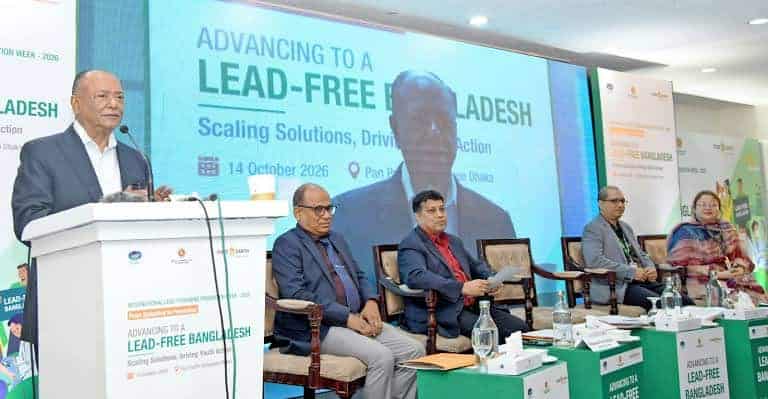
Bangladesh has shared a complete plan to fight lead pollution. This plan aims to keep children, public health, soil, water, and cities safe in the long term.
On 17 October 2026, the “National Lead Pollution Action Plan 2026–2035” was unveiled during a high-level policy meeting in the capital, attended by the Ministry of Environment, Forest and Climate Change, Bangladesh; the Ministry of Health and Family Welfare; the Ministry of Industries; and international development partners.
Lead pollution is no longer just part of industrial pollution. It now harms how children think, puts workers at risk, affects the health of pregnant women, and slows down human development. Consequently, failing to bring this pollution under control will expose the nation’s future generations to a silent yet persistent health risk.
Country’s Environment Minister Abdul Awal Mintu said at the meeting that, to stop lead pollution, Bangladesh needs to move from reacting to problems to being proactive and using data.
Lead pollution is not just one event; it is the result of many problems in our factories, the quality of things we buy, how we handle waste in cities, and people not knowing enough. Therefore, the solution must also be integrated, scientific, and long-term.”
Key Aspects and Implementation Framework of the Action Plan:
The new action plan creates a national guide based on five main parts: finding sources of lead pollution, putting rules in place, improving legal checks, watching public health, and ensuring a safe market for consumers.
Relevant government departments have found unsafe levels of lead in different industrial areas, battery recycling sites, paint factories, printing facilities, metal-processing plants, and even in some contaminated food products sold in stores. Experts say that without good rules and careful monitoring, this harmful metal will slowly damage the environment and public health.
Regulating Industrial Sources and Reforming Licensing:
It was decided that high-risk industrial facilities will be brought under a new environmental licensing framework. Mandatory emission rules will be set, especially for industries that recycle batteries, smelt metals, process old paints, and use lead-based materials. Exceeding established lead emission limits will result in immediate fines, suspension of production, and mandates for facility-level reforms.
Child Health and Local Screening Programs:
Under the supervision of the Ministry of Health, a specialized screening program will be launched to measure blood lead levels in children living in high-risk urban and industrial areas. In the first phase, priority will be given to vulnerable zones in Dhaka, Narayanganj, Gazipur, Chittagong, Khulna, and Rajshahi. Additionally, it was decided to implement health camps, awareness-raising consultations, and nutritional support programs for pregnant women, factory workers, and residents of low-income settlements.
Market Oversight for Safe Paints, Toys, and Consumer Goods:
Product quality control officials must test goods made in the country and those brought in from abroad, like paints, toys, ceramics, cosmetics, and kitchen items, regularly. Strict surveillance will be enforced to eliminate the use of low-quality, lead-containing paints in children’s rooms, schools, hospitals, and residential buildings. Furthermore, it was announced that labeling standards in the market will be strengthened to ensure consumers’ right to access accurate information.
Public Awareness and Community-Based Prevention:
In collaboration with local government bodies and city corporations, awareness campaigns will be conducted in schools, mosques, community centers, marketplaces, and areas where workers reside. An awareness campaign will begin to inform the public about how lead can enter the body. This happens through playgrounds for kids, school walls, old paint, clay dishes, and unsafe food.
Expert Opinions and Public Health Concerns:
Health experts note that once lead enters the human body, it is not easily eliminated. Instead, it can cause permanent damage to the nervous system, kidneys, blood cell production, and the cognitive development of children. Often, it inflicts harm gradually without presenting acute symptoms, leaving individuals unaware that they have been exposed to contamination.
In children, in particular, the risks of low IQ, attention deficits, learning difficulties, and behavioral problems increase. Consequently, this action plan is viewed not merely as an environmental measure, but as a national initiative to safeguard human resources.
Environmental experts further caution that as industrialization accelerates in Bangladesh, proceeding without safe technologies, stringent standards, and regular audits will lead to mounting, silent health risks alongside economic progress. They argue that failing to take immediate action to control lead pollution will place an immense, compounding burden on the healthcare sector in the future.
Conclusion and Green Page’s Perspective:
Lead pollution is a silent yet profound crisis that simultaneously impacts the environment, public health, and the economy. Green Page believes that if the Bangladesh government’s 2026–2035 National Action Plan is rigorously implemented at the grassroots level, it will not only curb pollution but also set a new benchmark for fostering children’s cognitive development, ensuring worker safety, and establishing a secure consumer market.
From Green Page’s viewpoint, a truly ‘green’ Bangladesh can only be realized when every industrial facility, marketplace, school, and household in the country becomes a partner in building a lead-free future.