

More than 4 million vehicles ply the streets of Dhaka daily. Although private cars account for only 5–7% of this volume, they occupy approximately 70% of the road space. About 90% of the population relies on public transport. Research by BUET shows that traffic jams in Dhaka cause a yearly economic loss of about 3–5 billion US dollars.
Excessive vehicular traffic is driving up air pollution, creating a risk of premature death for around 80,000 people in the city each year. To build a livable city, there is no alternative to establishing an integrated transport system that prioritizes walking, cycling, and public transport while curbing the use of private cars.
Speakers expressed these views during a human chain program titled “Fewer Cars, Livable Cities,” held on Tuesday, 22 September 2026, at 08:00 in front of the Abahani Playground on Satmasjid Road, Dhanmondi. The event was organized through the joint initiative of the organizations behind World Car-Free Day. This report is based on a press release by WBB.
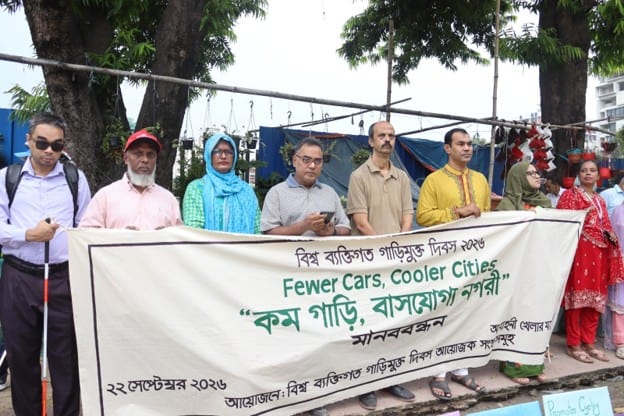
Presided over by Helal Ahmed, General Secretary of the anti-drug organization ‘Prottasha’, and moderated by Mithun, Assistant Project Officer at Work for a Better Bangladesh (WBB) Trust, the event featured welcome remarks by Naima Akter, Project Manager at WBB Trust. Other speakers were Humayun Kabir Sumon (General Secretary, Green Voice), Aminul Islam Tubbus (President, Cycle Lane Implementation Council), Madhab Chandra Sarkar (Executive Director, Visually Impaired Development Organization), Zakir Hossain (President, Disability Different Program – DDP), Sifat Harun (President, Cyclists of Bangladesh), Marina Akter Banu (Research and Demonstration Coordinator, CDP), M A Mannan Monir (Founder, Dhaka Ideal Cadet School), Tahajjat Hossain (Assistant Teacher, Rayer Bazar High School), Farzana Akter Shimu (Assistant Teacher, Kochikantha High School), Shamsunnahar Panna (Assistant Teacher, Laurel International School and College), Redwan Rahat (Chhayatol Bangladesh), Munna (Head of Environment, Dhrubotara Youth Development Foundation), Gaus Peari (Director, WBB Trust), Syeda Ananya Rahman (Head of Programs, WBB Trust), Talukdar Rifat Pasha (Policy Officer, Institute of Wellbeing Bangladesh), and Md. Shahidul Islam and Firoz Rahman (Nagorik Forum).
The speakers observed that Dhaka city is facing constant challenges due to a lack of planned urbanisation. The city’s population is growing fast, making it well-known for traffic jams. This is due to more travel needs and more cars. Approximately 76 percent of trips within Dhaka cover a distance of less than two kilometers. Creating a safe and comfortable environment for walking would encourage many people to walk and refrain from using private cars for their daily activities.
The speakers further noted the recent hike in fuel prices, which places a direct burden on people’s daily commuting and household expenses. Because fuel prices are increasing, we must limit private car use. We should improve public transport, walking, and biking to be safer, less expensive, and easier to access. Cutting down on extra car use can save fuel, lower transport costs for homes, reduce traffic jams and air pollution, and create a better, more sustainable city life.
Recommendations made during the event included: building and keeping wide, safe sidewalks for people while controlling private cars; making walking, biking, and public transport the main ways to travel in the city’s plan; taking strong action against illegal parking; adding bike lanes, route networks, bike parking places, and bike-sharing programs on major roads; promoting biking among students in schools and universities; creating a connected transport system that combines walking, biking, buses, trains, and boats; making sure women, kids, and disabled people can use city transport; enforcing speed limits in crowded places like schools, homes, and markets; educating people about the health, environmental, and money-saving benefits of walking, biking, and public transport; spreading awareness about traffic rules; and ensuring that police and authorities enforce traffic laws strictly.
Representatives from various organizations, including officials from the Institute of Wellbeing Bangladesh and Work for a Better Bangladesh Trust, were also present at the end.