
Dr. Nusrat Hafiz
Asst Prof & Women Empowerment Cell Director, BRAC University
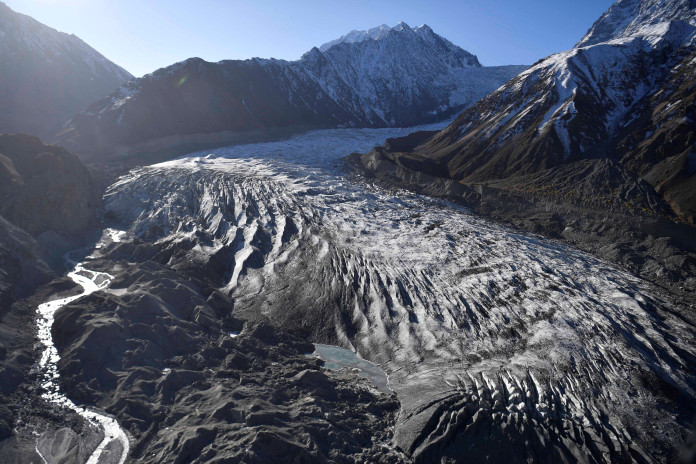
On August 26, 2026, a chunk of glacier roughly 2,000 feet wide broke off a mountain near the Nepal-China border and fell nearly 7,000 feet into the valley below. The impact was so violent it was initially mistaken by seismic monitors for a magnitude 4.4 earthquake, before scientists confirmed it was a glacial collapse that triggered a devastating landslide.
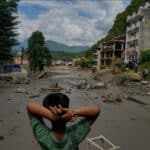
What followed was a wall of water, ice, and rock that tore down the Bhote Koshi and Trishuli rivers into Nepal’s Rasuwa, Nuwakot, and Dhading districts. In places, the river rose by as much as nine metres, nearly 30 feet, in just thirty minutes.
By the following day, nearly a thousand people were reported missing across Nepal and Tibet, and UNICEF estimated more than 17,000 children in Nepal were left in urgent need of humanitarian help.
For most Bangladeshis reading the news, this will register as a tragedy that happened somewhere else, sad, but distant. It isn’t distant. It’s upstream.
Why this is Bangladesh’s problem too
Think of the Ganges-Brahmaputra-Meghna river system as one long staircase of water, with Bangladesh sitting at the very bottom step. Nepal, Tibet, and the Indian Himalayas sit at the top. Whatever happens at the top, a glacier collapsing, a monsoon dumping extra rain, a dam under strain, eventually arrives at the bottom, whether we had anything to do with it or not.
Experts have already pointed out that the Brahmaputra carries this exact risk downstream from Assam into Bangladesh, where it joins the mighty Padma, meaning a serious event upstream, even one far outside our borders, has real potential consequences for us.
This isn’t a future hypothetical, either. Even without any single dramatic event like Nepal’s, climate modeling shows that glacial melt in the Himalaya-Tibetan plateau could increase water flow in the Ganges, Brahmaputra, and Meghna rivers by as much as 54 to 81 percent during severe floods by 2030 under high-emissions scenarios.
And the pressure is already visible this season: in the very same week as the Nepal disaster, the Teesta river was sitting at its warning level and the Brahmaputra-Jamuna was on a steady rise expected to cross danger marks within days, putting low-lying districts on alert, entirely independent of what happened in Nepal.
Put plainly: Bangladesh doesn’t need a glacier to collapse on its own soil to suffer the consequences of one collapsing somewhere else. We are already, structurally, one of the most exposed places on Earth for this kind of risk.
By one global assessment, Bangladesh tops the list of flood-prone countries worldwide, with roughly a fifth of its land vulnerable to submergence and 60 percent of its population exposed to high flood risk, a level of exposure surpassed only by the Netherlands.
What needs to be done, and when
The uncomfortable truth is that the technology to warn people often already exists. It is the delivery that fails. Flood forecasting in Bangladesh largely works at the national level, but the communication chain breaks down between the district and the community, particularly where people lack access to the media channels warnings are shared through.
Fixing that isn’t a five-year infrastructure project; it’s a matter of building reliable local relay systems, before the next monsoon season, not after it.
There are three time horizons worth thinking about separately. Immediately, before the next monsoon (roughly April–May), warning delivery should be stress-tested and reinforced in the districts already flagged as highest-risk, the Teesta and Brahmaputra-Jamuna belt (Lalmonirhat, Nilphamari, Kurigram, Gaibandha), the haor basin (Sylhet, Sunamganj, Habiganj), and the hill districts (Bandarban, Rangamati, Khagrachhari, Cox’s Bazar). During this dry season (roughly October–March), the low-water window should be used to inspect and reinforce embankments, pre-position emergency supplies in the highest-risk unions, and finalize regional data-sharing arrangements on upstream river and glacial monitoring, a task that depends on cooperation among Bangladesh, India, Nepal, and China. On an ongoing basis, household and community-level financial resilience needs building: savings buffers, accessible microinsurance, diversified income, so that when a flood does hit, it costs a family a disruption rather than everything they own.
Where scholars come in
Forecasting data is only useful if it reaches the right person in time to act on it, and that is fundamentally a research problem, not just an engineering one.
Encouragingly, Bangladeshi researchers are already building tools for exactly this: a machine-learning early warning system for the country’s flood-prone haor wetlands recently flagged high flood risk a full 72 hours before water levels approached danger marks in a live 2026 test, giving communities meaningfully more lead time than a simple gauge reading would.
That is the kind of applied, locally grounded research the moment demands, not just describing the risk, but shortening the gap between knowing and acting.
Scholars also have a role in testing what actually works before it’s scaled nationally. A Yale-BRAC partnership is currently running a randomized controlled trial testing whether local entrepreneurs can sustainably sell desalinated water in Bangladesh’s salinity-affected coastal communities, rigorous evidence, not assumption, about whether a resilience solution genuinely holds up.
Where entrepreneurs come in
Research identifies what should work; entrepreneurs are the ones who get it into people’s hands. In Kurigram, one of the districts most exposed to exactly this kind of upstream flood risk, a local initiative introduced a portable water filtration system and trained community members, many of them women, as “ambassadors” managing distribution, turning disaster preparedness into a livelihood rather than just a relief effort.
Elsewhere, women running small businesses in disaster-prone areas have used their earnings to build monthly savings of BDT 10,000 to 20,000, which is itself a form of resilience, a buffer a family can draw on when a flood disrupts everything else.
Researchers have even begun naming this pattern formally, describing it as “community-based adaptive entrepreneurship”, an entrepreneurial model built specifically to help climate-vulnerable communities absorb and recover from environmental shocks.
For coastal and riverine small businesses specifically, the practical shifts are concrete: salt-tolerant crop and aquaculture varieties, jute-based products as alternatives to conventional materials, and climate-adapted business models like mangrove-based fish farming.
The point of connecting the two
Neither role works well alone. Research without a delivery mechanism stays in a journal. Enterprise without evidence risks scaling the wrong solution.
The partnerships that are actually working, a university trial validating a business model, a local entrepreneur network distributing what the research says is needed are the template worth replicating, and quickly.
Nepal’s disaster is a warning delivered from upstream. Bangladesh’s response shouldn’t wait for the water to arrive before it starts listening.